
Federal BOP Release Destinations
A person leaving a BOP institution may enter the community, a residential reentry setting, federal supervised release, immigration custody, or another authority's custody. The locator result does not narrate every next step. “Released” identifies a BOP event. “Not in BOP Custody” states only that BOP does not currently hold the person. Either result can coexist with probation, supervised release, a state or local booking, an immigration hold, or a completed federal sentence.
No BOP prison is located in Pennington County. A Pennington County Jail record may still show transfer to a federal authority. That is not a community release from the county booking. Ask the Sheriff for the transfer date, legal basis, and receiving entity. Then check the federal system named in the record. If the person served a sentenced federal term, the BOP locator is appropriate. If the person was a pretrial prisoner in U.S. Marshals custody, the holding facility and federal docket are more useful.
Search Federal BOP Releases
The official BOP Inmate Locator offers number and name searches. The number route accepts a BOP register number, DCDC number, FBI number, or INS number. The name route uses exact first and last name, with optional race, age, and sex filters. An identifying number is stronger when common names or spelling variants could cause a false match.
- Choose number search when an official identifier is known.
- Otherwise enter the exact federal name.
- Use age, race, and sex only to separate possible matches.
- Compare the register number and identity fields.
- Read the listed location and release date together.
- Preserve the exact wording of the custody result.
- Check the federal docket or receiving agency for the next event.
Results can show name, register number, age, race, sex, release date, and location. A date may be recalculated, so an earlier screenshot should not override a current official result. When identity or the sentence is unclear, use the federal case number and judgment to reconcile the record.
Federal Release Record Fields
BOP fields are compact but useful when read in context. The register number anchors the identity. Location can name a facility, “Released,” or “Not in BOP Custody.” The release date supplies a federal event date but does not explain a county handoff, a later arrest, or the start and end of federal supervised release.
| BOP field | What it supports |
|---|---|
| Register number | Unique federal prisoner match |
| Name | Identity as recorded by BOP |
| Age, race, sex | Comparison among similar names |
| Release date | BOP's recorded or projected federal release date |
| Location | Current facility or BOP custody wording |
Do not rewrite “Not in BOP Custody” as “free.” The person may be with U.S. Marshals, ICE, a state DOC, a county jail, or in the community under a supervision order. Likewise, a Pennington roster absence cannot be turned into a BOP release without a federal match.
Note: Report the locator's exact federal wording and date, then name any separate source used for the next custody status.
Federal BOP Locator Screen
The official BOP locator displays both the number-search and name-search routes used for federal release research.
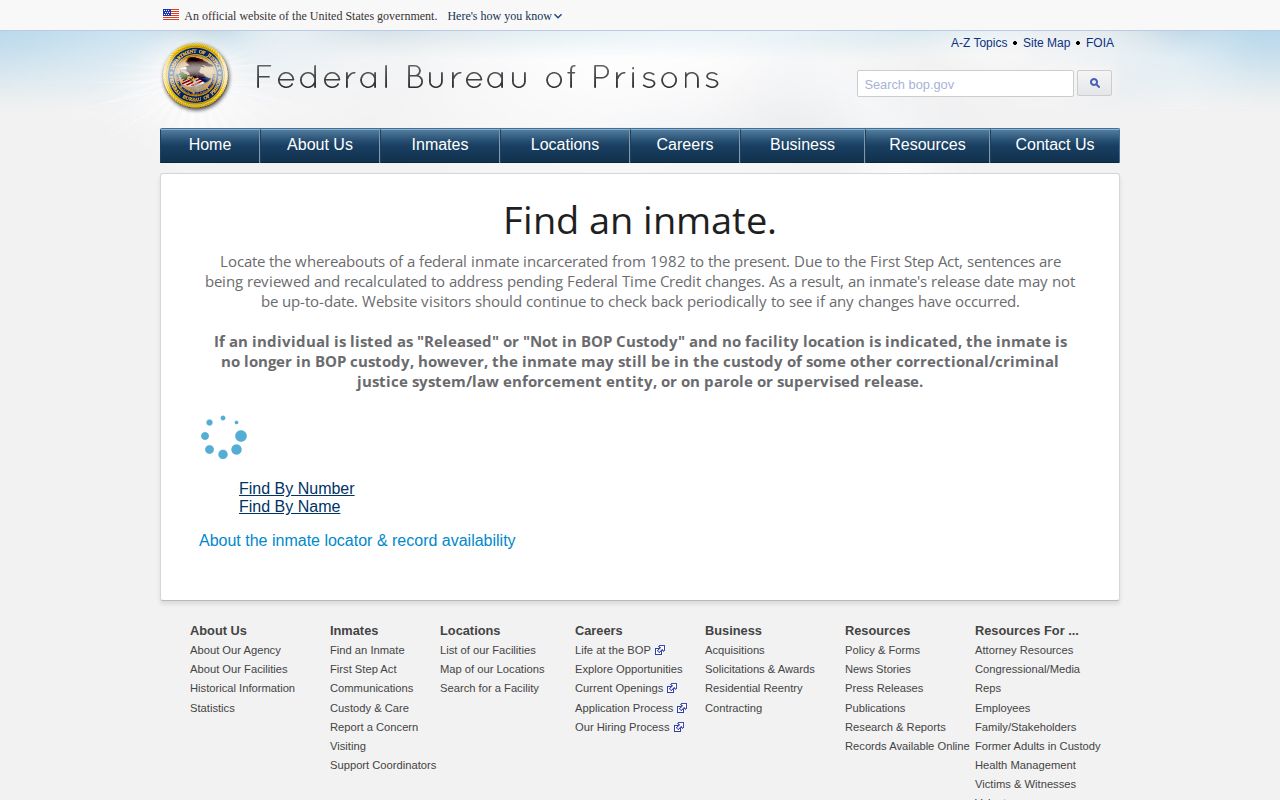
The screen is a national tool. It does not represent a BOP facility in Pennington County. Use it only after the facts point to a sentenced federal prisoner, and compare the result with the federal court file or known receiving authority.
Pennington Federal Transfer Record
Minnesota public arrest data provides the best bridge from the county jail to a federal system. Under Minn. Stat. §13.82, subdivision 2, request the date and time of transfer, its legal basis, and the receiving agency or person. Ask for the booking number and release fields in the same response so the county event is not confused with the later federal result.
If the recipient is listed as BOP, search the BOP register number if one is available. If the record says U.S. Marshals, identify the partner holding facility and federal case. USMS owns no detention facilities and uses local, state, BOP, and private capacity. A person can move among those facilities while remaining in federal pretrial custody. BOP's sentenced-prison locator may not be the right tool during that stage.
The Pennington County released inmate record path covers the Sheriff's request channels. Corrections can route an urgent question, while a written Records Division response is better for the exact handoff. Preserve both the Pennington transfer event and the later federal status as separate facts.
Federal Marshal Custody Records
The U.S. Marshals Service manages federal pretrial prisoner custody and transport, but it has no public individual locator comparable to BOP. It also states that it owns no detention facilities. A federal prisoner may be held at a partner county jail, state site, BOP facility, or private facility. The building name and federal docket are therefore central to confirmation.
Start with any Pennington Sheriff transfer response. Then search the federal court docket for detention, release, transport, sentencing, or commitment entries. Contact the known holding facility for its own public process. If a historical agency record is needed, a narrowly framed USMS FOIA request should specify the person, date range, record sought, and preferred electronic format. Privacy and law-enforcement exemptions may limit the response.
- BOP custody
- Sentenced federal prison custody recorded in the BOP system.
- USMS custody
- Federal pretrial or transport authority using partner facilities.
- Federal supervised release
- Court supervision in the community after custody.
- Federal transfer
- A handoff that continues custody rather than returning the person to the community.
Federal Release Supervision Record
A BOP release date does not show the full term of federal supervised release. Supervised release is imposed by the federal court and managed in the community after incarceration. The judgment and docket identify the term, later modifications, alleged violations, and discharge when those entries are public. BOP's locator focuses on prison custody and release, not the full supervision history.
Compare the register number and release date with the federal case. If the docket shows a transfer to immigration custody, follow ICE rather than assuming a community exit. If it shows a violation and remand, a new detention event may follow. Remand means the court orders custody. One older “Released” label does not override a later booking in a different system.
Keep conclusions narrow: BOP reports release on its date; the federal court shows supervised release; USMS reports or the partner facility shows custody; ICE reports detention. This wording stays accurate even when agencies overlap.
A federal court order can explain the legal basis for a release without proving the minute that a person left a partner jail. Match the order date to the facility record. If the person moved from Pennington County custody, request the local transfer fields as well. That record may show the federal handoff before BOP assigned a register number or institution. The sequence can therefore include county booking, USMS partner custody, federal sentencing, BOP placement, BOP release, and later court supervision.
Confirm Federal Inmate Release
Begin with identity, then scope. Use a register number whenever possible. Record BOP's location wording and release date. Next, check the federal docket for supervision or a handoff. If Pennington County Jail was the last known local custodian, obtain the Sheriff's transfer data. A match across those records can explain the movement from county custody to federal custody and, later, out of BOP.
When the BOP locator has no match, revisit spelling and identifiers. The person may never have been in BOP, may be in USMS partner custody, or may belong to a state or immigration system. Do not force a federal conclusion from a missing result. The correct final statement names the agency and event: “BOP reports Released,” “BOP reports Not in BOP Custody,” or “Pennington records show transfer to a federal recipient.”
A result should also be checked against time. BOP release dates can be recalculated, and an old capture may not reflect a later sentence change. Compare the current locator with the judgment and recent docket entries. If the docket identifies immigration pickup, use ICE next. If it identifies a state writ or local case, search that named authority. If federal supervised release remains active, the court record and probation office, not the prison locator, describe that community phase.
If a current federal result conflicts with an older Pennington record, preserve both dates and ask the agency that created each record. The county document proves its handoff. The BOP locator proves the federal prison status at the time checked. Neither source should be rewritten to answer the other agency's event.