
Pennington County Supervision Types
A person can leave the Pennington County Jail and still have legal duties in the community. Probation usually follows a court order that stays part of a sentence or sets community terms. Supervised release is the community part of a Minnesota prison sentence. Parole is not the routine label for that prison transition. The Minnesota Supervised Release Board reviews only narrower groups, including some life, indeterminate, and conditional-release cases.
The distinction controls where to look. A court file can show probation, its conditions, revocation activity, and discharge. The Minnesota Department of Corrections Public Viewer can show a person under supervised release or intensive supervised release, the date that status took effect, the district, an agent, and an expiration date. A jail roster does not establish either form of supervision.
| Status | Source | What it means |
|---|---|---|
| Probation | Sentencing court and assigned office | A court-ordered community sentence or stayed-sentence term. |
| Supervised release | MNDOC Public Viewer | The community portion of a state prison sentence. |
| Parole or board release | Supervised Release Board records | A board process for limited statutory categories. |
| Discharge | Court or DOC record | The relevant supervision or DOC jurisdiction has ended. |
Verify Pennington County Supervision
Start with the last known sentence, not a guess based on where the person lives. The county office handles both local probation and state supervised-release work, but there is no public database listing every probationer. Public sources must be combined with a careful office inquiry.
- Check the Pennington court case for the sentence, probation order, revocation, or discharge entry.
- Search the MNDOC Public Viewer by offender ID when available, or compare a name match with date of birth.
- Read Current Status and its effective date before looking at the expiration field.
- Note the named field office, district, and agent when the public record supplies them.
- Call the listed supervision office for process questions, recognizing that staff may limit person-specific details.
- If no DOC result appears after a full discharge, request maintained history from MNDOC Central Records.
The public example in the MNDOC Public Viewer shows the community-supervision record layout.
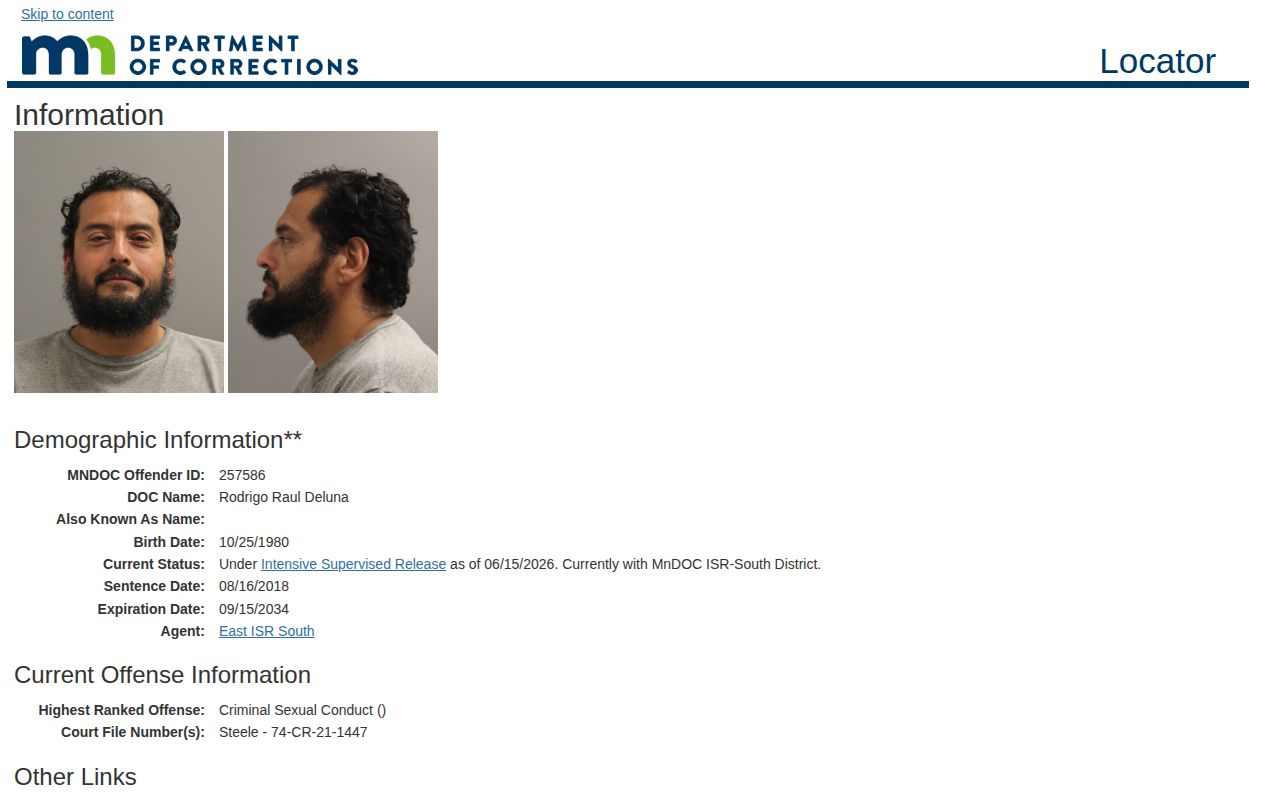
The screen demonstrates why status, effective date, supervising district, expiration, and agent should be read as separate fields. It is a format example, not a claim about any other person.
Note: A person missing from the county roster may have been released, transferred, or moved to another custodian, so absence alone proves no supervision status.
Pennington County Supervision Office
The MNDOC Thief River Falls District and Pennington County Field Office serves Pennington and Marshall Counties. The county describes its work as misdemeanor, gross-misdemeanor, felony probation, and supervised release. It is a community office, not a jail, and a person reporting there has left institutional custody while remaining subject to an order.
Call before visiting because the two official sources publish different phone numbers. The county number and the current MNDOC directory number should both remain visible until the agencies reconcile them. For a detailed state record that no longer appears online, MNDOC Records Management can be reached at 651-361-7330 or CO-Records.DOC@state.mn.us.
Pennington Supervision Phone Conflict
This local discrepancy matters. Silently choosing one number can send a caller to an outdated route, while publishing both preserves what each official source states. The Pennington County supervision page gives 218-683-8520. The MNDOC field-office directory gives 218-681-0901 for the same Thief River Falls district.
A call should focus on the correct office and process. Have the full name, MNDOC offender ID or court file number, and known status date ready. Staff can explain where an official request belongs, but an office conversation may not replace a maintained record. A court order proves what the judge ordered. A DOC status-effective date is stronger evidence that a prison exit into community supervision occurred.
Pennington Warrants After Release
A local warrant and a DOC fugitive entry answer different questions. Pennington County’s warrant information concerns court or Sheriff processes that may exist after an earlier jail release. MNDOC describes a fugitive as a person serving the community part of a sentence who allegedly violated release and is evading authorities. Neither source is a live jail roster.
An absconder is a person alleged to have stopped reporting or otherwise avoided supervision. A fugitive entry does not mean the sentence ended. It signals that MNDOC alleges a violation during the community phase. The DOC fugitive tip line is 651-603-0026. A local warrant may also coexist with probation, another case, or a prior release event. Check the issuing source before stating what the entry means.
Note: A warrant or fugitive listing can follow a valid earlier release and should not be restated as proof of present physical custody.
Pennington Release Conditions and Violations
Conditions depend on the sentence and supervising authority. They can include reporting, travel limits, treatment, payment, or other case-specific duties. Public records may show broad terms, while operational details may be restricted. A violation allegation can lead to a warrant, revocation hearing, return to custody, or a change in supervision. It is not itself a final finding.
Revocation means a court or corrections authority withdraws all or part of a community status after the required process. Intensive supervised release is a more restrictive DOC community status, not incarceration at the field office. If a person returns to prison after revocation, Current Status may change from a district to a correctional facility. Read the new effective date and do not keep using the old community status.
The court record can preserve a probation-revocation filing, hearing, amended order, jail credit, or later discharge. That legal history does not show the minute of physical booking or release. Match it with Sheriff custody data if an alleged violation led to the Pennington jail, and with the DOC status record if it led back to state custody. An allegation is not the same as a completed revocation order.
Office staff may limit person-specific details for privacy or safety reasons. Ask which public record or responsible agency can confirm the procedural fact at issue. The secure Statewide Supervision System is not a public directory of every probationer, so an online gap is not proof that supervision ended.
Pennington Parole Board Limits
Most Minnesota determinate sentences do not wait for a parole-board vote. The ordinary structure moves an eligible person from prison to supervised release by statute. The Supervised Release Board, operating since July 2024, serves specified life, indeterminate, and conditional-release categories. Its schedule, agendas, approved minutes, and recordings are useful only after confirming that the sentence belongs to a board-reviewed class.
For such a case, first confirm the sentence in the DOC record. Then check the Board schedule and agenda, and read approved minutes for a grant, denial, or continuance. A projected or granted date is still not the actual custody transition. The later DOC Current Status and effective date provide the public confirmation. Ordinary Pennington County probation cases do not become board cases merely because people use the word parole in casual speech.
Pennington Supervision Terms Defined
Closely related terms mark different stages, so a short definition prevents a false claim about release.
- Probation
- A court-ordered community term, often tied to a stayed sentence.
- Supervised release
- The community portion of an ordinary Minnesota prison sentence.
- Parole
- A release route used for limited sentence classes reviewed under applicable law.
- Absconder
- A person alleged to be evading required community supervision.
- Revocation
- A formal action that can end community placement and return a person to custody.
- Discharge
- The end of the identified supervision term or DOC jurisdiction.
Expiration is not the same as the prison release date. It generally refers to the projected end of sentence jurisdiction. For the broader custody and release-record path, use the Pennington County released inmate search and match each event to its originating office.
Pennington County Status Records
County probation and DOC supervision may be handled from the same local office, yet their records arise from different orders. A misdemeanor probation term can remain a Pennington court matter without a public DOC profile. A prison case can remain visible in the Public Viewer because the Commissioner still has jurisdiction after the person returns to the community. Thus no DOC result does not mean no probation, and a community DOC result does not mean final discharge.
MCRO can trace the court side of supervision. A Register of Actions may preserve the sentence, a probation-revocation filing, a hearing, an amended order, jail credit, or a later discharge entry. That legal history does not provide the minute of a physical booking or release. Match it with Sheriff custody data when a violation led to the Pennington jail, and with the DOC status record when it led back to state custody.
A status-effective date identifies when the displayed DOC phase began. It may mark movement from prison into supervised release, from ordinary supervision to intensive supervision, or from community status back to a facility. Expiration points to the expected end of DOC jurisdiction, subject to lawful change. Reading those dates together prevents the error of calling the prison exit an unconditional end to the sentence.
If an online profile has vanished, contact Central Records instead of concluding that the person was never under MNDOC authority. The Public Viewer focuses on people who remain under current DOC jurisdiction and is not a complete archive of every fully discharged sentence.